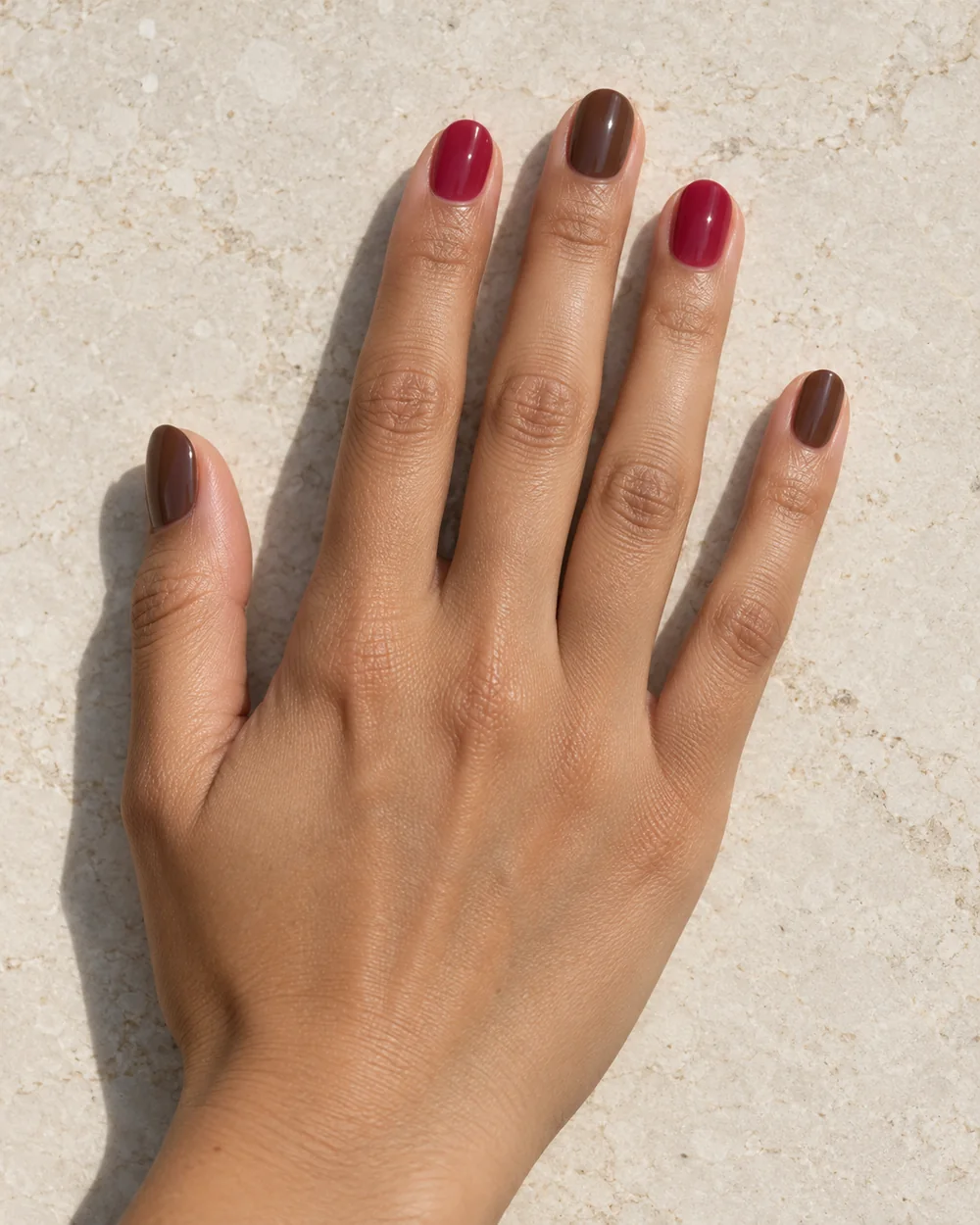
Coffee brown and raspberry jelly create two different kinds of colour. Brown can behave as a solid block beside clothes and jewellery. A jelly-like raspberry tint lets more of the nail show through. The choice is therefore not just brown or red; it is also opaque or translucent.
Both colour directions appear in Pinterest’s October 2026 beauty report. The illustrated hand alternates the two families so their different colour roles are easy to compare.
Two colour jobs
Coffee brown supplies a grounded, continuous area. Choose its depth by the contrast you enjoy against your hand: a milky coffee, mid brown and very deep espresso give different impressions. Raspberry jelly supplies a coloured transparent layer. Its pink-red balance can be warm or cool, and the natural nail remains part of what you see.
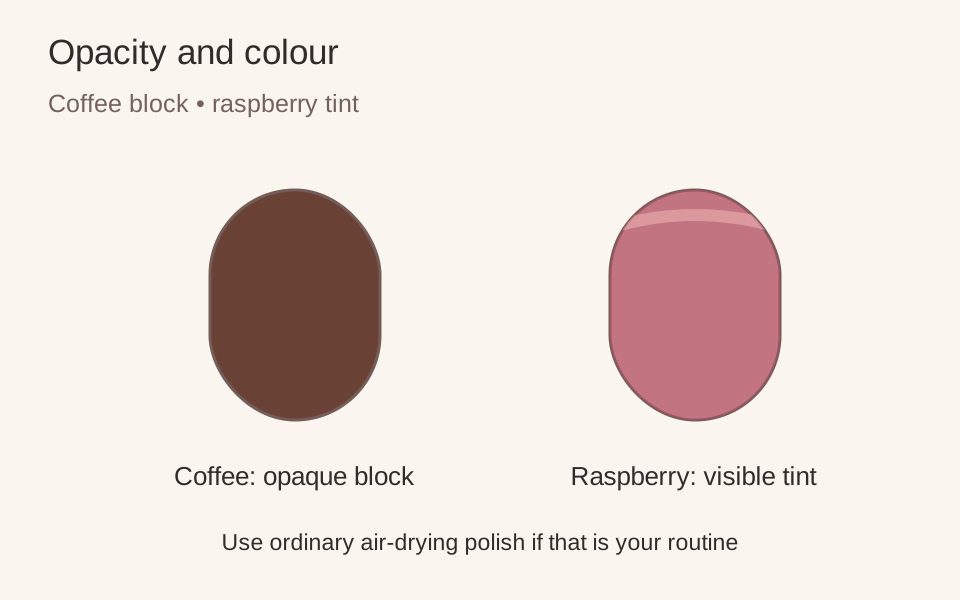
Jelly is used here as a description of the translucent appearance. Look for an ordinary air-drying polish if that is your chosen routine; you do not need to adopt gel, a curing lamp or extensions to explore the colour. Read the actual product directions rather than assuming that a finish name tells you how it cures.
Compare a small amount first
If you already own the shades, use separate practice nail tips or one accent nail to see them in the number of coats the directions allow. With a sheer raspberry, more layers may deepen the tint without making it behave like an opaque red. If you want to hide the natural free edge completely, an opaque formula may be a simpler choice.
With coffee brown, look for the undertone you like beside your everyday clothing. A red-brown reads differently from a cooler grey-brown. You do not need to select a shade that makes the hand look lighter or darker. The useful comparison is how much contrast and continuity you want.
Choose a whole manicure or a deliberate pair
A single colour across every nail gives the simplest result. To combine them, repeat a pattern you can explain, such as alternating colours or one raspberry accent among brown nails. Keep nail shape and gloss similar if you want the colour difference to be the main feature. A different colour on each nail is also possible, but it adds another decision.
Follow labelled application and removal directions, use ventilation, keep the products away from heat and eyes, and avoid coating surrounding skin. These points follow FDA nail-product guidance. The colour lesson does not require cutting cuticles or changing nail length.
Your final edit
Look at the nails while holding a familiar bag or wearing a regular sleeve. If you want a firmer colour statement, choose the opaque brown. If you like seeing the nail through the colour, keep the raspberry tint. Buy a second finish only if that different visual job is something you will actually use.
Adapt the design, nail length and colours to your preferences. Follow the directions on your own nail products.