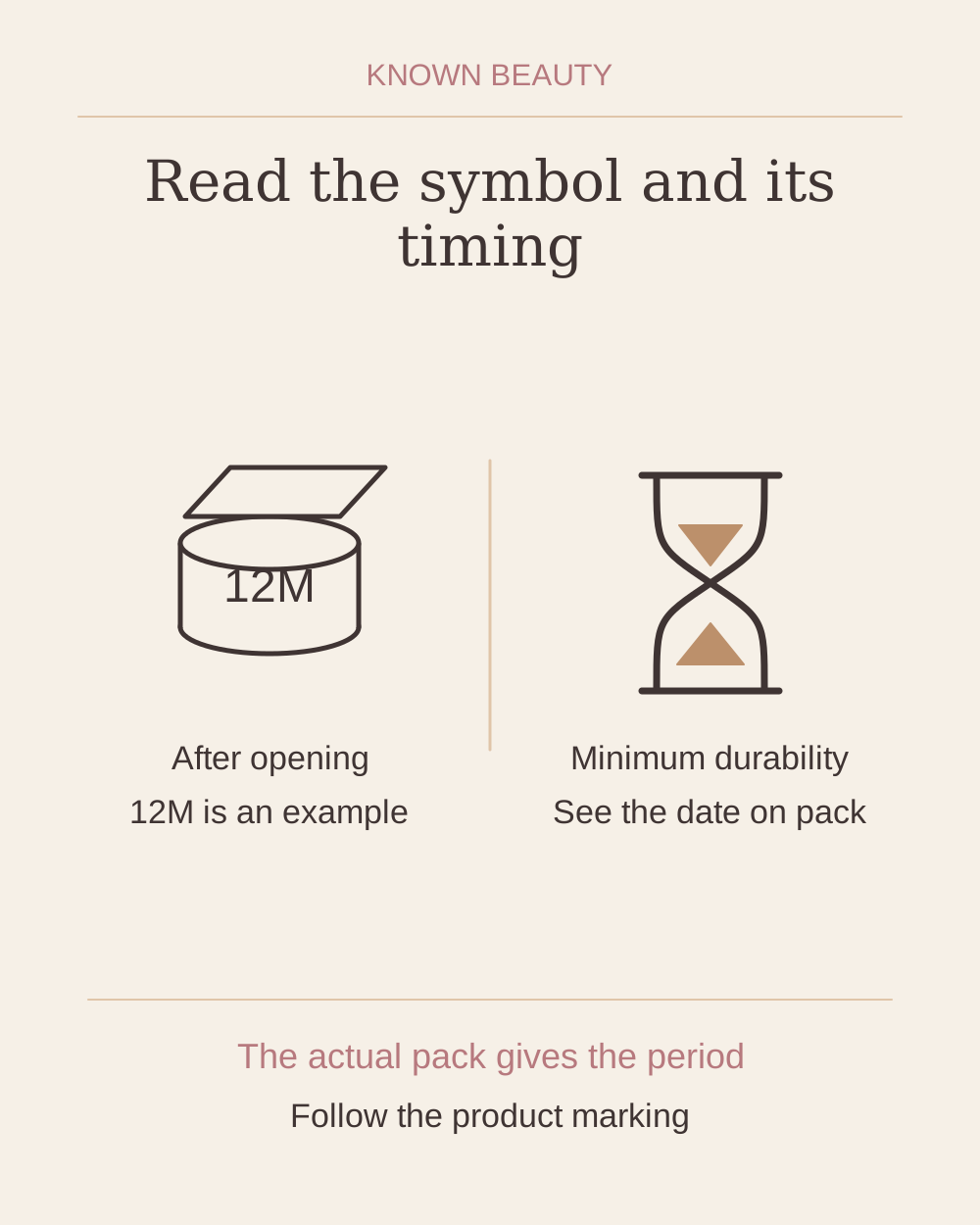
A tiny open jar on a compact or tube is useful information, but it can be easy to miss when the outer carton goes straight into the recycling. Take a moment to find the relevant marking before adding a product to your bag. The aim is a record you can actually use, rather than a universal chart that gives every lipstick or palette the same deadline. Product-specific directions come first.
Understand the two main markings
| Marking | What it tells you | Your next step |
|---|---|---|
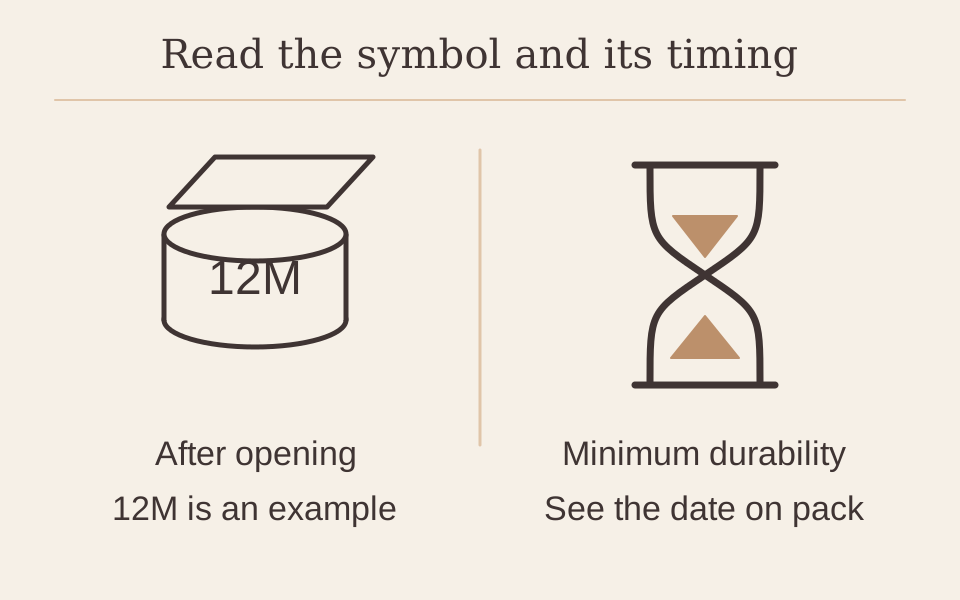
| A best-before date, sometimes with an hourglass symbol | The product’s minimum durability under the stated storage conditions | Follow the stated date and storage guidance; a date is not a reason to keep using a product that has changed. |
| An open jar with a number and M | A period after opening, expressed in months | Note the opening date and calculate a reminder from that date. |
| A batch or lot code | A manufacturing reference used to identify the batch | Keep it available if asking the brand about the product. |
| A hand-and-book symbol | Further product information is provided elsewhere | Look for the enclosed or attached information. |
Why the same marking is not on every product
The CTPA explains that products durable for thirty months or less need a date of minimum durability. Products durable for more than thirty months may require a period after opening where deterioration after opening could cause harm; there are exceptions where the concept is not relevant. This explains the different types of label. It does not let you infer a missing date from the category, the price or how recently you bought it.
Make a small opening-date record
- Find the full information. Check the container, carton and any leaflet before discarding packaging. Take a clear photo of tiny printing, the product name and shade so you can connect the instructions to the right item later.
- Write the actual opening date. Use a small label where it will not cover instructions, or keep a phone note. Record first opening, rather than the shopping date, when the pack uses a period-after-opening symbol.
- Translate the marking once. For example, a 12M marking on an item first opened on 10 January gives a reminder for 10 January the following year. This is an illustration of reading the symbol, not a recommended lifespan for any category.
- Keep storage guidance alongside it. A calendar reminder cannot make unsuitable storage acceptable. Keep the manufacturer’s directions with your record and close the container as instructed after using it.
- Review before replenishing. Check the record while tidying your kit. If you cannot establish the relevant information, ask the manufacturer rather than allowing a third-party batch-code website to become your only source.
When the information is unclear
| Situation | Useful action | What it does not establish |
|---|---|---|
| You cannot remember opening it | Look for a dated photo, note or purchase record; ask the brand if uncertain | A receipt alone does not prove when it was opened. |
| The printing has rubbed away | Use a saved carton photo or ask the brand with product and batch details | A similar-looking product may use different directions. |
| No open jar is visible | Check the full pack and leaflet before asking the manufacturer | Its absence alone does not prove the product is counterfeit. |
| The product appears unchanged | Still follow its marking and directions. Discard it if its colour or smell changes, even before the marked period ends | Appearance alone cannot certify that continued use is safe. |
Keep the record attached to the product
A simple inventory needs only product name, shade, batch reference, opening date and the relevant marking. Store those details together, especially if you own two similar tubes. Avoid moving an unknown remainder into an unlabelled pot: the container, identity and instructions then become harder to track. Our makeup-bag reset shows how to separate everyday items from things that need a decision.
Questions worth asking
Does unopened mean it lasts indefinitely?
No. Read the product’s actual durability and storage information. A period-after-opening symbol should not be turned into a claim of unlimited unopened storage. Ask the manufacturer about an old unopened item if the guidance is unclear.
Can I restart the clock by cleaning the outside?
No. Cleaning packaging does not create a new first-opening date or replace the product’s directions. Keep the original record rather than giving an older item a new label.
Should every product have both markings?
Not necessarily. The CTPA explains that the labelling approaches are alternatives and that exceptions exist. Read the complete pack rather than assuming a missing second symbol is an error.
Choose tools and products for the job you need. Check the directions, care information and any compatibility guidance for your own items.