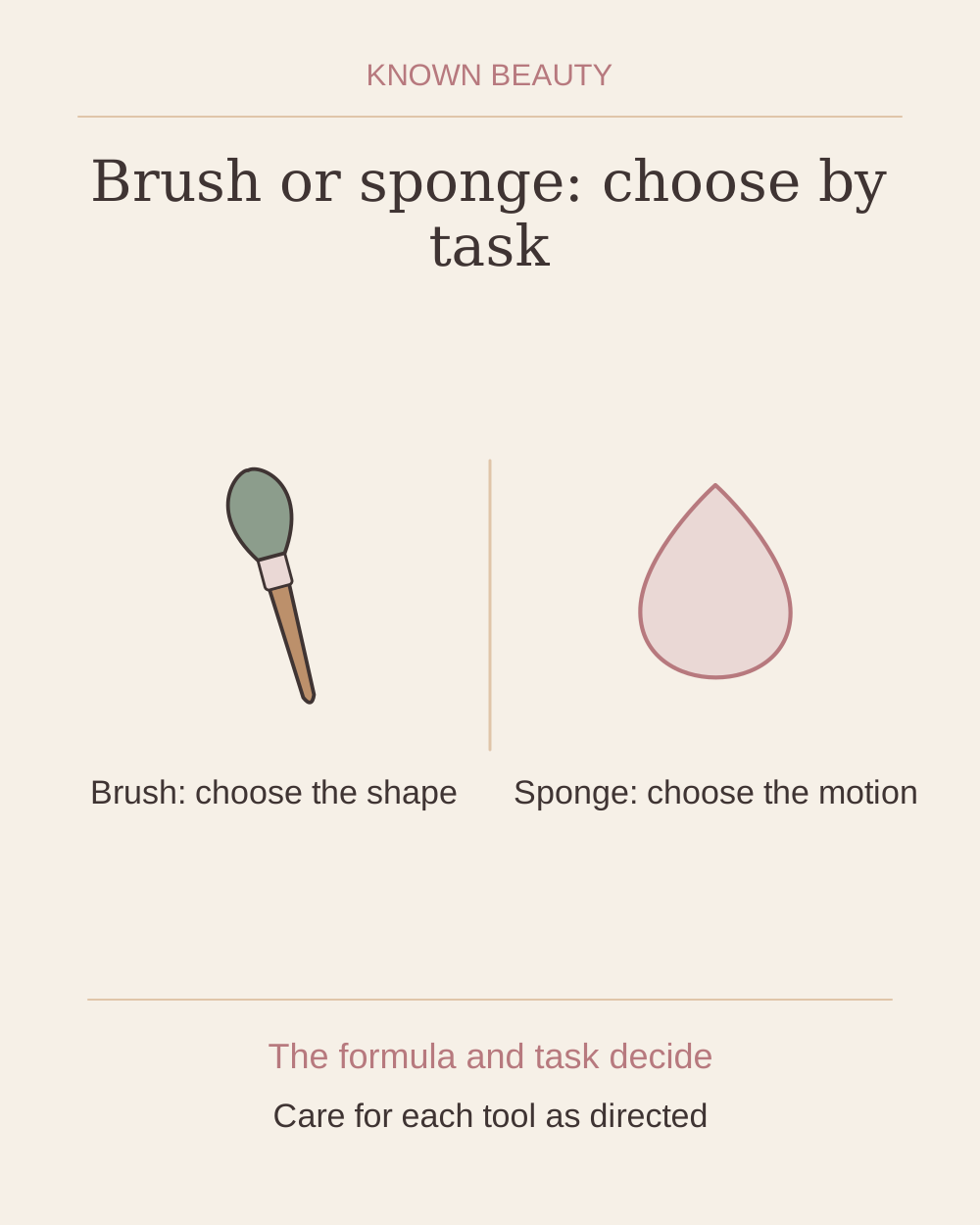
A brush or sponge is a choice about the movement you need, the formula you use and the care you can manage. Start with the task that feels awkward. You may need a different pressure or working area rather than a different collection of tools.
| The job | A useful first comparison |
|---|---|
| Place concealer on a small area | A small brush can help you control where the first patch goes. |
| Soften a base boundary | Compare your familiar base brush with a compatible sponge, using light local pressure. |
| Add a light powder layer | Use a brush or puff suited to that actual powder and its directions. |
Choose the movement, then the tool
A broad sweep moves makeup differently from a small press. Try the movement the formula calls for, then look at where the colour ended up. Has the coverage stayed on the chosen area? Is the jaw boundary soft? Are repeated sweeps leaving marks or removing the patch you meant to keep?
Use the same familiar base for a comparison. Begin with a small amount and keep preparation similar, so a new primer or different formula does not obscure the tool decision. A note such as “this brush places this concealer accurately” is more useful than declaring a universal winner.
Check before adding water
Some sponges have damp-use instructions; others differ. Beautyblender directs users of its Original sponge to wet it, squeeze out the excess and bounce it. That is a direction for that product, not every sponge. A dripping tool also changes the comparison you thought you were making.
Count the care
Follow each tool’s cleaning, drying and replacement directions. Keep clean tools separate from used ones, and do not share eye cosmetics. The brush-cleaning guide applies to appropriate brushes; a sponge still needs its own maker’s advice.
Using a brush to place coverage and a compatible sponge at the edge is an option, not an extra step you owe the routine. Keep the tool that gives you the placement you wanted. Add another only when you can name its job.
Choose tools and products for the job you need. Check the directions, care information and any compatibility guidance for your own items.