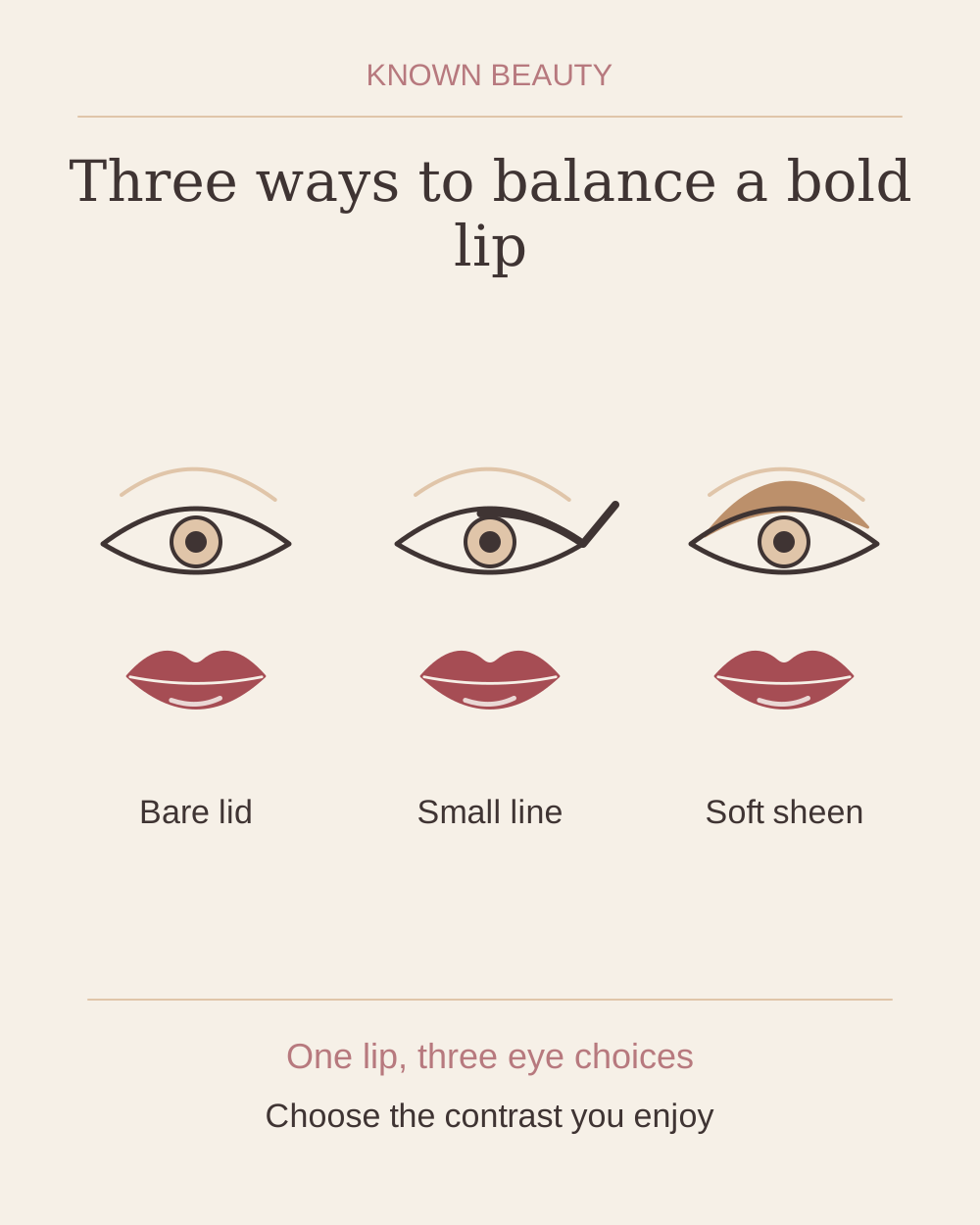
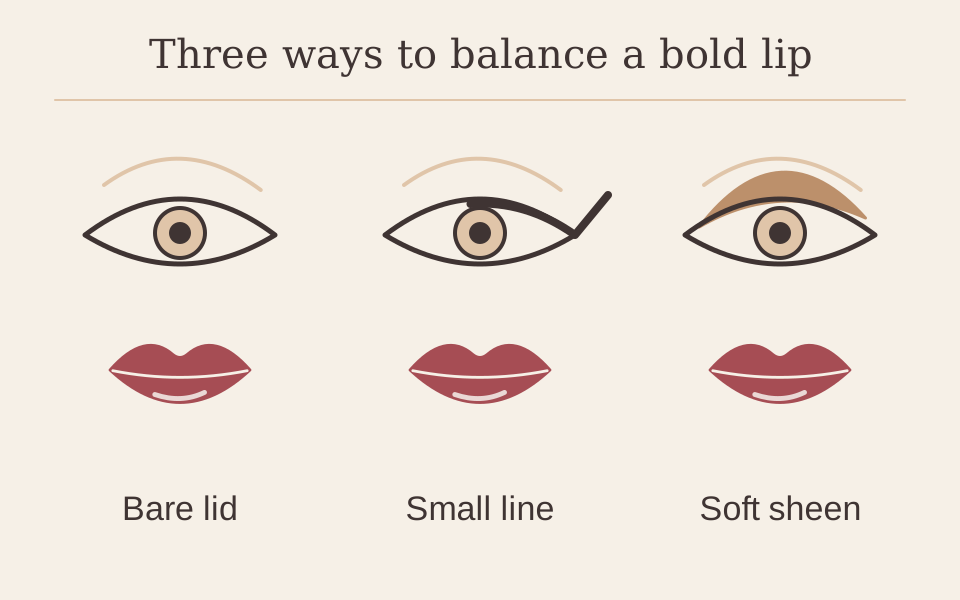
A bold lip can sit beside barely defined lashes, a short liner or a softly shaded lid. The useful question is how you want those elements to relate. You might want the mouth to lead, two crisp features to feel equally intentional, or an evening look with stronger colour in several places. None requires correcting your face or obeying a universal rule. Start with one of these combinations, then edit the amount of contrast rather than buying a new full-face kit.
Combination one: lip colour and a quiet eye
Choose a red, berry, brown or another colour you enjoy, then keep the eye routine to a careful mascara pass or a small amount of soft shadow. The lip provides most of the colour contrast. A sheer cheek in a related family can connect the face, but it is optional. This is useful when you want fewer application steps or when the lip outline is the skill you are practising. A quiet eye can still have visible lashes and brows; it does not mean making those features disappear.
Combination two: a bold lip and a short line
Pair the lip with a narrow upper-lash line or a short outer wing. Keep the line length and lip edge deliberate, then decide whether more shadow adds anything. The repeated idea is definition rather than identical colour. A brown line gives a different contrast from black, while the depth of the lip affects the whole impression. Use the soft brown-liner routine if you want to practise the eye step on its own first.
Combination three: a bold lip and a soft bronze eye
Sweep a small amount of bronze or another soft sheen across the visible lid, then soften the outer edge. Controlling the boundaries matters more than adding many colours. You can keep the cheek quieter if that makes the combination easier to assess, or include stronger cheek colour deliberately. There is no obligation to neutralise everything else because the mouth is colourful. The aim is a result you enjoy and can apply comfortably, not a formula that every face must follow.
Build the combination in this order
- Choose the lead feature. Decide whether lips lead, both features share attention or the eye is equally dramatic. This gives you a reason to stop or continue when you reach the mirror check.
- Complete the lip first for this exercise. Apply a light, even layer and make the boundary as soft or defined as you prefer. You can remove and refine one small section. Avoid making the whole outline larger merely to match a stray mark.
- Add the chosen eye structure. Follow one of the three combinations and keep its first pass small. Use eye-area products as labelled. If you are combining liner and shadow, finish the shadow shape before deciding how much liner it needs.
- Check from an ordinary distance. Look at the whole face, including the contrast from hair, frames and clothes if you are ready to go out. A close mirror view can make every detail feel equally urgent, even when the overall look is already clear.
- Edit one variable. If the combination feels busier than you wanted, soften the eye boundary, reduce cheek colour or choose a different lip sheen. Change one thing, then reassess. You can also keep the stronger combination if it matches your intention.
Choose your approach
You have five minutes for the eye step
Choose mascara or a short soft line alongside the lip. Spend the saved time checking the lip corners and carrying a touch-up product.
You want an evening experiment
Try the soft-sheen option with a familiar lip. Practise before the event so you can judge the combination without a deadline.
When the combination feels different from the plan
| What you notice | Try this next |
|---|---|
| Every feature feels equally strong | Choose a lead feature again and reduce one other element. Look at contrast and area before assuming the colour family is wrong. |
| The eye looks unfinished beside the lip | Add a little lash definition or a narrow line. A complete eye does not require a full lid of shadow. |
| The colours seem disconnected | Repeat a related undertone in a light cheek or shadow choice, or simplify to fewer colours. Exact matching is optional. |
| The lip centre wears away | Refresh the area after checking it in a mirror. A strong outline does not remove the need to assess the colour inside it. |
Questions you might have
Must a bold lip go with neutral eyes?
No. A quiet eye is a useful starting option, while a defined or smoky eye can be intentional too. The distinction is your chosen visual weight.
Does bold mean red?
No. Depth, opacity and contrast against your own colouring can make many colours feel bold. A berry or brown can carry the same role.
Practise the outline with lip liner for beginners, then compare the softer version in the berry-lip look.
Makeup placement and colour are personal choices; adjust the steps to suit you. Follow the directions on your own products.