Monochromatic makeup builds a look around one colour family. It does not require identical pink on every feature. A dusty rose lid, warm rose cheek and deeper rose lip can feel connected while doing different jobs. Begin with the product you already enjoy most and make the other colours companions. This is a styling suggestion, not a rule about which rose belongs with a particular skin tone.
Choose your rose anchor
Put three products beside one another and choose which should be most noticeable. Start with the lip or blush if that feels easier than choosing an eye colour. Pink products are not automatically interchangeable across the face: check permitted areas of use. A lip product should not become eyeshadow unless labelled for that use. Use the actual products to compare, rather than expecting an illustrated palette to match real shades.
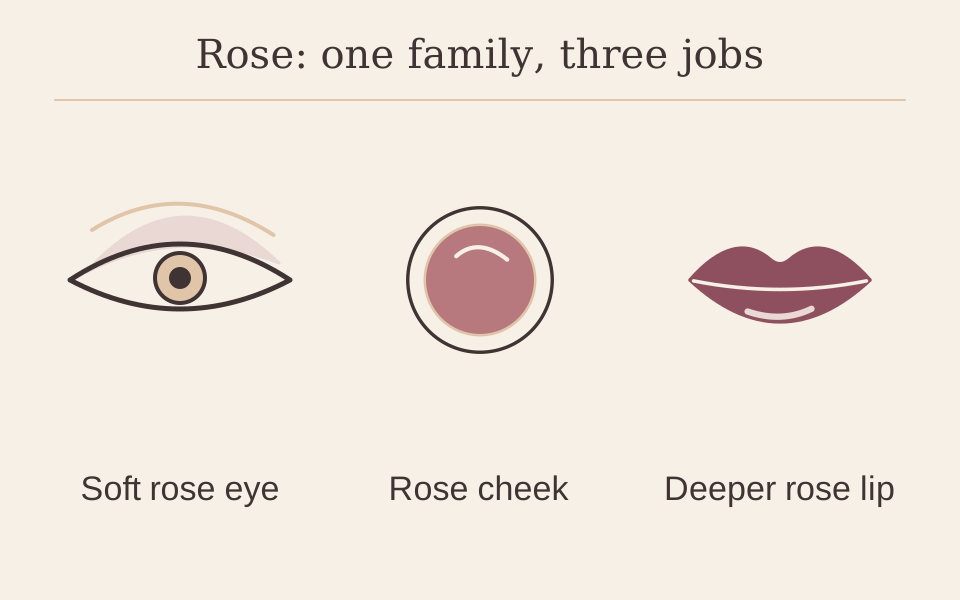
Build a related palette
- Lay down your usual base. Apply only the coverage you want, blending its boundary into the surrounding skin. Leave room to see the effect of cheek colour before adding extra base. Targeted concealer instead of foundation is a complete option. The rose palette does not depend on a particular coverage level or completely even-looking complexion.
- Place a light rose on the lid. Use an eye product intended for the area and start on a small visible part of the lid. Check with eyes open before extending it. A softly edged patch is enough. If it nearly disappears, decide whether you enjoy that subtle effect before switching to a deeper option or adding several layers.
- Give the eye a boundary if wanted. A little brown or plum definition near the external upper lashes can separate the rose from the lash line. Keep it narrow and soften the edge only if the formula permits blending. Add familiar mascara if you use it. Leave the lower lash line out of the first version while you assess the colour.
- Connect the cheek. Start with a small amount of rose blush and blend its outer boundary. The cheek can be warmer, deeper or more muted than the lid. Compare both sides with your face relaxed, then step back before another pass. You are making a relationship between colours rather than trying to produce three equal blocks of pink.
- Let the lip complete the palette. Apply a light layer, then check how its depth changes the balance. A deeper lip can lead; a sheer lip can leave the cheek as the focus. Use a compatible liner for a defined edge, following the short-section method. Compare the whole face in ordinary light before finishing.
Choose your approach
Soft throughout
Keep the colour light and use finish to distinguish areas: a fine lid sheen, satin cheek and sheer lip, for example. Each finish remains your choice.
One deeper feature
Choose a richer lip or more eye depth while the other rose areas stay softer. This gives the repeated colour a clear focal point.
Keep each colour useful
| What you notice | Check first | Try next |
|---|---|---|
| Shades feel unrelated | Is one much brighter or warmer than planned? | Change one companion shade next time; keep the anchor you enjoy. |
| Everything looks equally pink | Compare the amount on each feature. | Soften cheek or lip instead of adding neutral products everywhere. |
| The eye looks flat | Does the visible lid have one uniform depth? | Add a little neutral definition near the upper lashes. |
Build from your existing makeup
You do not need a coordinated collection. Choose colours with a connection you can describe: muted, warm, berry-toned or softly rosy. If that connection is unclear, try just cheek and lip first. Record the pair you like so your next attempt starts from a useful decision rather than another shopping list.
Questions you might have
Can one stick do everything?
Only where its label permits. “Multi-use” alone does not confirm eye-area use; check the directions.
Does monochromatic mean no brown liner?
No. A neutral line can support the palette. The repeated rose provides the theme; every cosmetic need not share it.
What if I prefer a deeper lip?
Use it as the focus. The berry-lip guide offers another way to organise a related colour family.
Makeup placement and colour are personal choices; adjust the steps to suit you. Follow the directions on your own products.