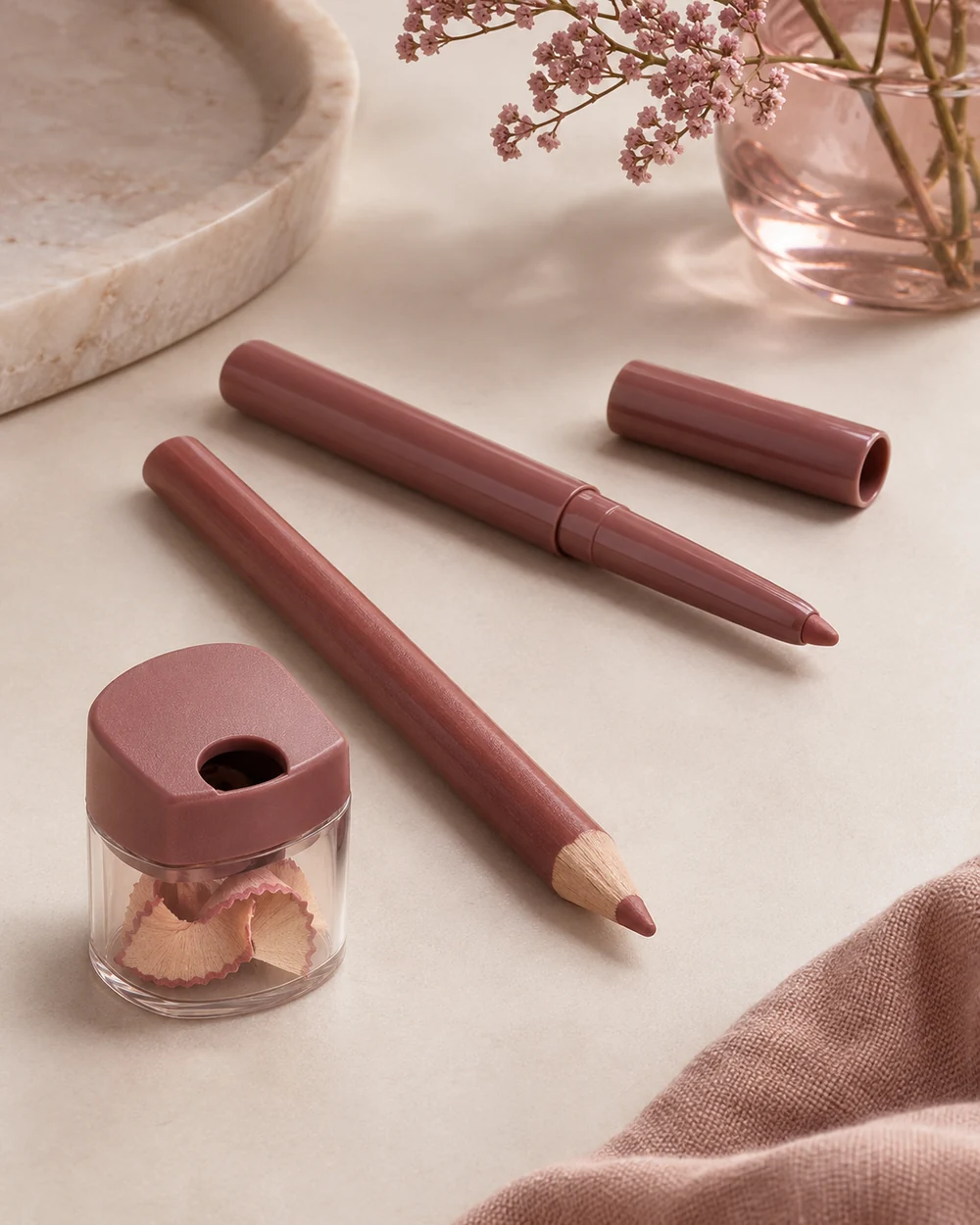
The useful lip-liner tool is the one that fits the pencil in your bag. Check whether the product sharpens, twists up or has a separate tip-refining mechanism before buying anything. A smooth barrel or blunt-looking end does not answer that question reliably.
Some familiar pencils are sharpenable despite looking like a sealed tube. Charlotte Tilbury explicitly says its Lip Cheat sharpens rather than twists up. Other products are automatic: Clinique’s Quickliner For Lips is extended by swivelling, and its instructions say that this particular design does not retract. Do not force a barrel in either direction to find out.
Match the opening before the colour
For a sharpenable design, use a cosmetic pencil sharpener of the diameter its maker recommends. The pencil should enter without being forced. A double-opening tool may be useful when you own regular and jumbo pencils; NYX’s own description distinguishes those two sizes. Two holes are not a reason to replace a single-opening sharpener that already fits your one pencil.
Look at the tool’s care instructions and how the shavings catcher opens. You need to empty it and reach the intended cleaning area without putting fingers against a blade. A catcher is useful for a bag, but it still needs emptying; it does not make a dirty tool ready to use.
Give the point only the work it needs
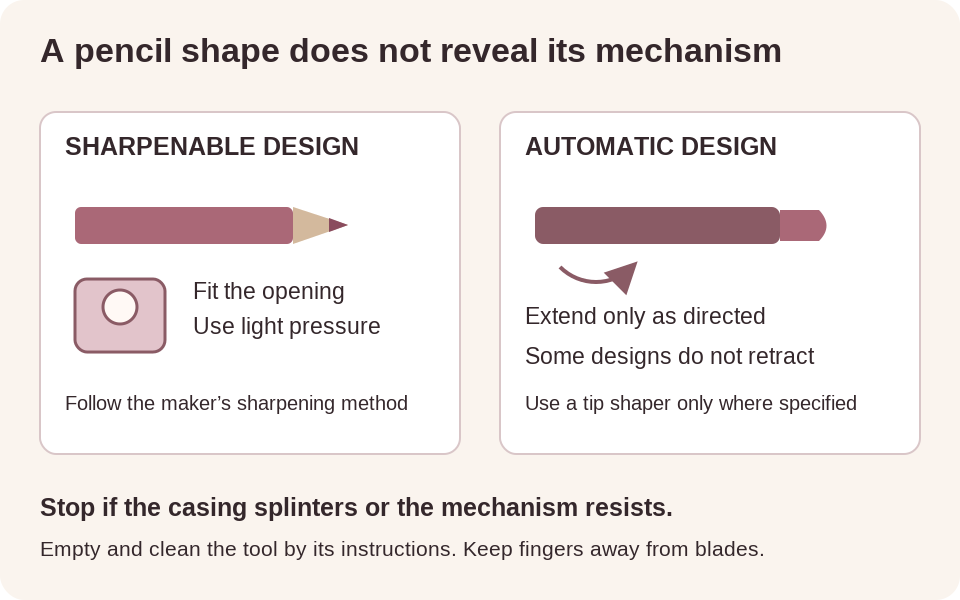
Hold the pencil and tool steadily, away from your face. Use the maker’s method with light, controlled pressure. Charlotte Tilbury’s directions use gentle rotation of the pencil; do not turn that example into a universal instruction for a different mechanism. Stop to inspect the tip before removing more material.
A short, usable point is enough for the beginner lip-edge practice. You are preparing a surface you can control, rather than trying to produce the longest possible needle point. After sharpening, check for loose shavings or a damaged casing before bringing it to the lips.
For an automatic design, expose only the amount directed. Do not assume you will be able to wind a long section back inside. If the pencil includes a tip shaper, use it only as instructed. Its presence does not mean the whole barrel belongs in an ordinary sharpener.
If the point keeps breaking
Stop sacrificing more pencil in the same attempt. Check the opening size, trapped shavings, visible tool damage and the product’s actual mechanism. Empty or clean the sharpener by its instructions, then let it dry where required before reuse. Do not dismantle a blade or dig out a blockage with your fingers.
If the casing splinters, the tool drags or the tip repeatedly breaks with a fitting tool and light pressure, contact the maker rather than applying more force. A different tool may solve a size or blade problem, but a fresh sharpener is not proof that the pencil itself is sound. Heating, freezing or adding liquid is not a universal repair method; leave those experiments out unless the maker gives instructions for your exact product.
Recap the pencil as directed and store the cleaned tool so loose shavings stay away from the products you apply. The next purchase should answer a specific gap: a different opening, a damaged sharpener or easier cleaning access. A second lip colour can wait while the first pencil’s mechanism is still unresolved.
Choose tools and products for the job you need. Check the directions, care information and any compatibility guidance for your own items.