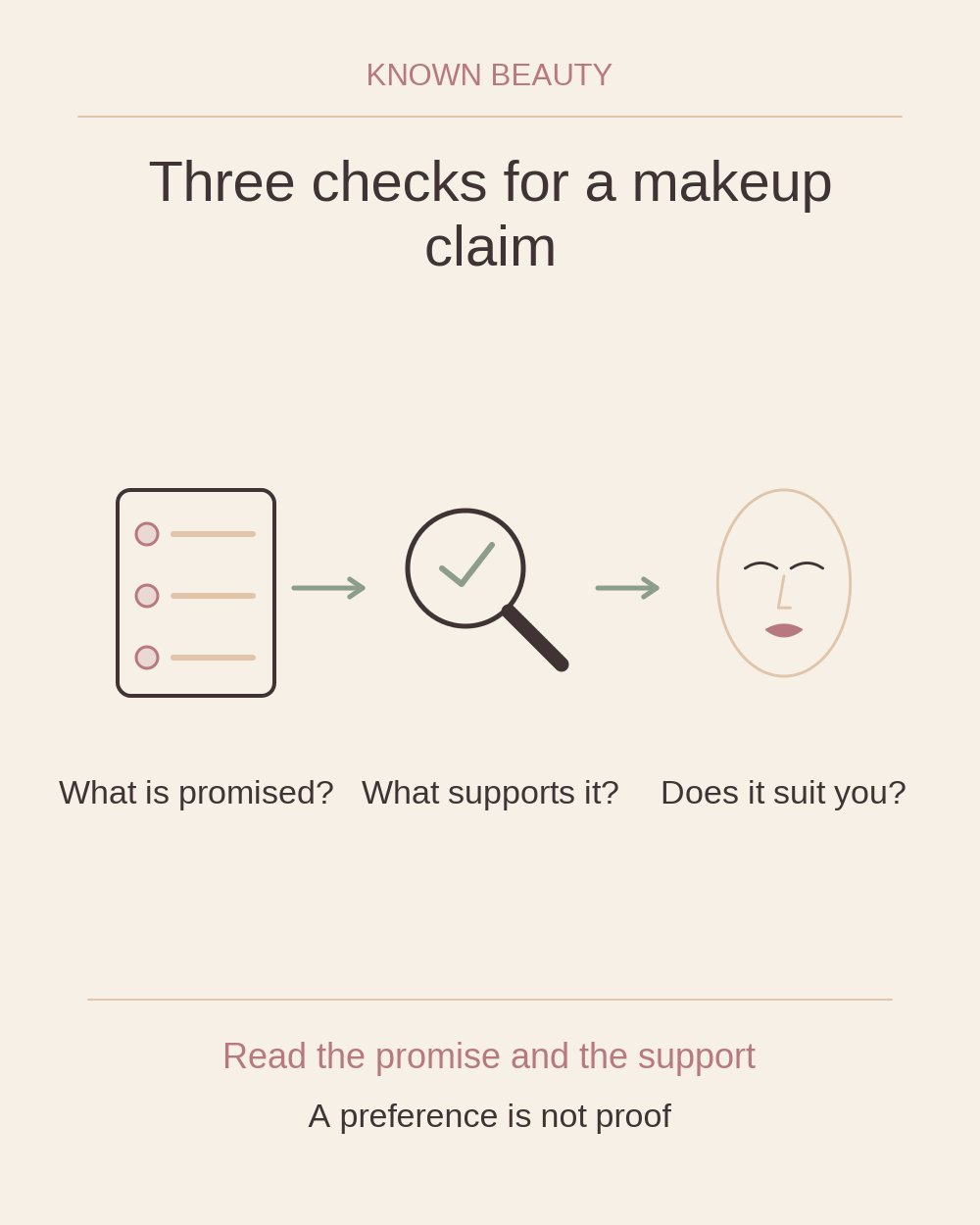
A claim can sound clear while leaving the useful detail out. “Long wearing”, “clinically tested” and “users agreed” describe different kinds of information. None tells you, on its own, whether a product does the job you want. Read the exact wording, find the qualification and compare it with your need before letting a headline choose your next purchase.
Sort the claim before judging it
| Claim type | A useful question | Keep the distinction |
|---|---|---|
| A finish description, such as satin | Do I like that appearance in a suitable sample? | Preference is not the same as a universal benefit. |
| A stated wear duration | What was measured, under which conditions? | A study result does not promise identical wear on everyone. |
| A consumer-agreement percentage | How many people answered, and what exactly were they asked? | Self-reported agreement differs from an instrument measurement. |
| An ingredient-led benefit | Is the evidence about this finished formula? | Information about an ingredient does not automatically settle product performance. |
| A product demonstration | What was applied, and are relevant conditions clear? | Lighting, preparation and other products affect what you can assess. |
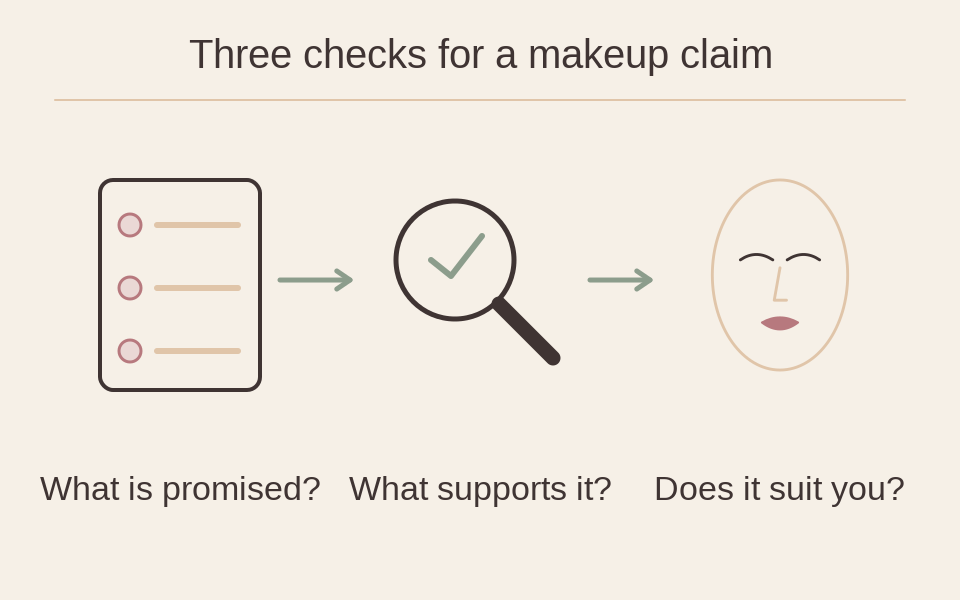
What the advertising guidance says
CAP’s substantiation guidance explains that advertisers should hold documentary evidence before publishing objective claims that can be substantiated. Its health-and-beauty guidance describes the need for evidence appropriate to the claim, including human trials where relevant. That is a responsibility on advertisers. As a shopper, you can use it to ask better questions; you are not expected to reproduce the regulator’s assessment or obtain a brand’s entire research file.
Read one claim in five passes
- Copy the exact sentence. Keep qualifiers such as “appearance”, “up to” or “users agreed”. Removing a few words can turn a limited statement into a much stronger promise than the advertiser actually made.
- Look for the small print. Find the test description near the claim, a footnote or the product’s detailed page. Note the sample size, duration and whether the result describes opinions, observation or measurement, where this information is available.
- Match evidence to product. Check whether the result relates to the finished product and version being sold. A discussion of a familiar ingredient or another formula is not automatically an answer about this one.
- Translate into your own task. If you want a sheer base for a short workday, a headline about full coverage may be irrelevant. Define your desired appearance, application time and removal routine before treating a large number as a benefit.
- Choose a proportionate next action. Ask the brand a specific question, seek a suitable sample or defer the decision. You do not have to declare a product excellent or misleading because one public page leaves a detail unclear.
If the wording leaves you uncertain
| What is missing | Ask this | Avoid assuming |
|---|---|---|
| A percentage without context | How many participants were included and what did they answer? | That the percentage describes every user. |
| A “tested” label without a result | What test was carried out and what did it show? | That testing necessarily means superiority. |
| A dramatic photograph | Which products, preparation and image processes were used? | That the photograph isolates one product’s effect. |
| A statement about an ingredient | What supports the claimed benefit for this finished product? | That ingredient research directly proves the headline. |
Keep your own trial modest and useful
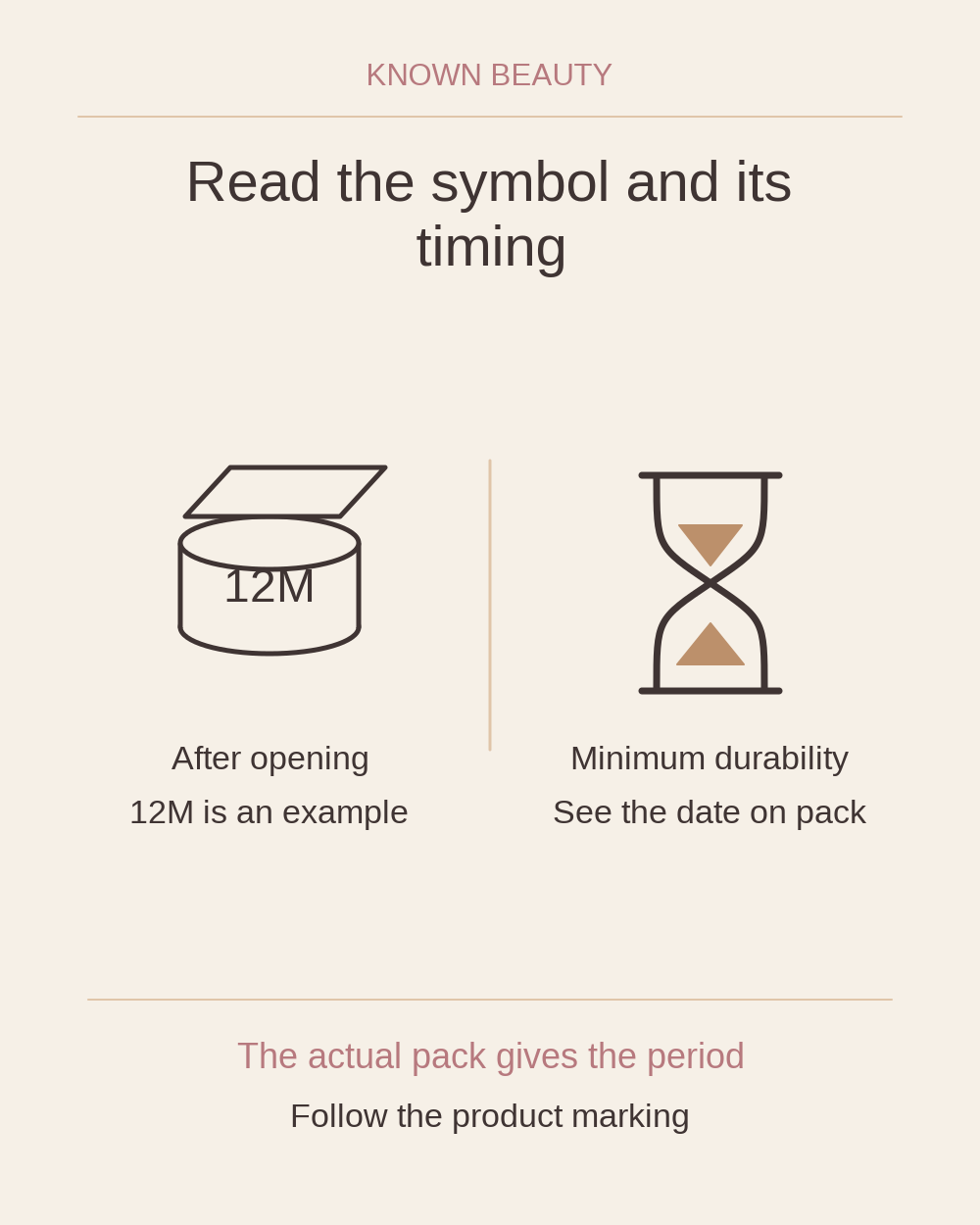
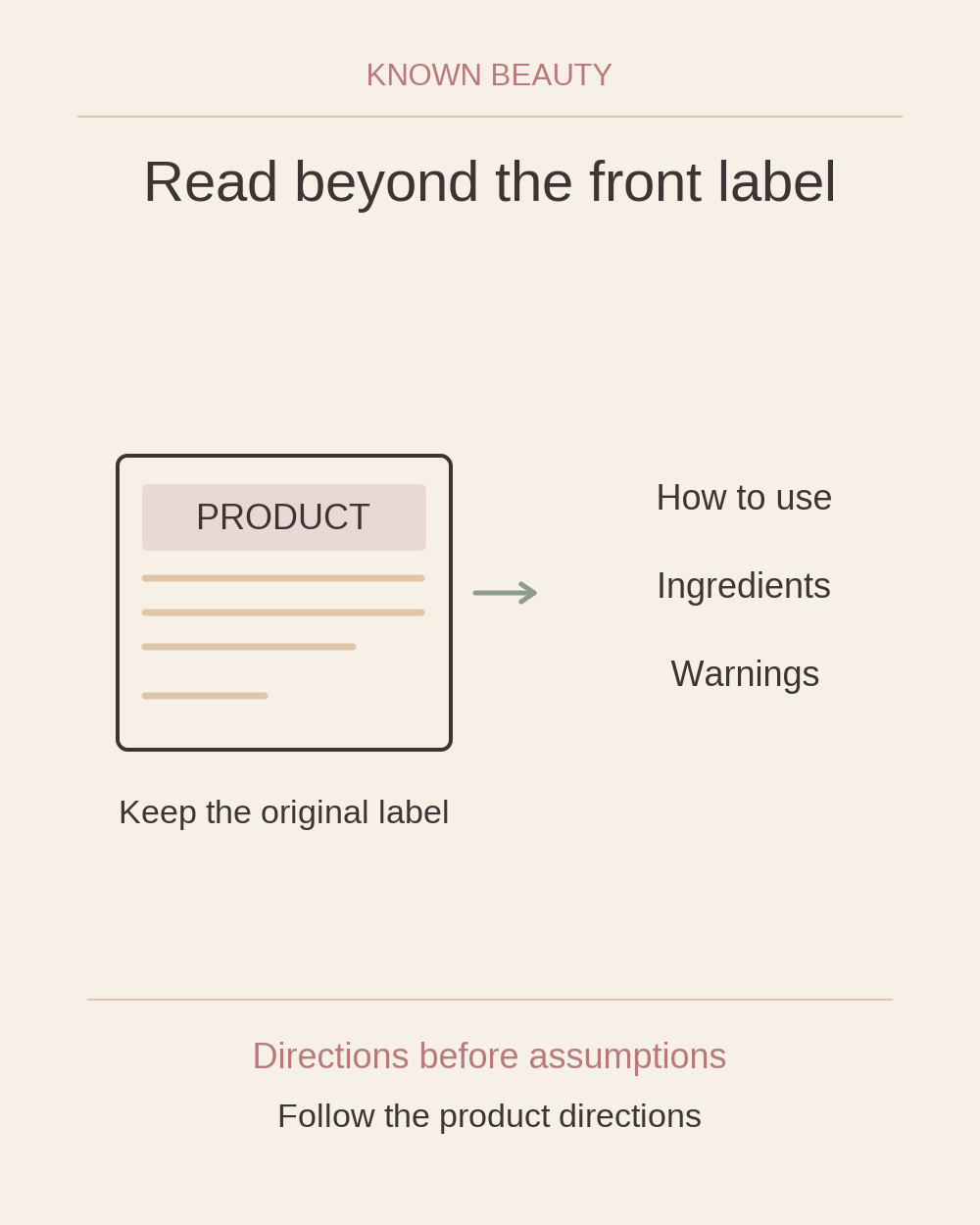
Where suitable sampling is available, compare one product under your normal conditions and follow its instructions. Note what you applied, how much, your preparation and what you actually noticed. “I liked the satin finish and found the applicator comfortable” is a useful personal conclusion. It does not become a clinical result, and it need not support the same conclusion for someone else. Our label-reading guide helps find the directions before you compare.
Questions worth asking
Does a testimonial prove a performance claim?
A testimonial records someone’s reported experience. It should not be treated as a substitute for suitable support for an objective claim. Ask whether the evidence actually answers the question the headline raises.
Does missing public detail mean a claim is false?
Not automatically. It may mean you need clarification. Keep your conclusion at the level of the evidence you can inspect, rather than inventing either a benefit or an accusation.
What can a beauty illustration show?
Treat an illustration as inspiration, rather than a demonstration of a product result. Known Beauty’s illustrations do not establish coverage, wear time, shade accuracy or treatment effects.
Choose tools and products for the job you need. Check the directions, care information and any compatibility guidance for your own items.